Mediterranean Editors and Translators (MET) celebrated 20 years of conferencing at METM25 in Barcelona in October. Here, attendees share their experiences of MET as an association and of MET meetings (METMs) over the years.
Despite its name, Mediterranean Editors and Translators encompasses a broad church of language professionals (not just editors and translators), who work in a variety of language-related fields and who may, or may not, live in or near Mediterranean countries. The annual meeting, therefore, offers a splendid opportunity to gather together and interact with other members and peers. And given the challenges currently facing language professionals, METM25 came at a pivotal moment, providing a chance to look back on 20 years of meetings but also to discuss ways forward for us all.
With sessions on editing as well as translation, and more besides, METMs offer something I haven’t gained from other conferences. Where else can I refresh my Catalan skills, receive a masterclass in nutrition, discuss the inconveniences of AI in literary translation, and ruminate on what we mean when we refer to ‘proofreading’ now? I gained all of this at METM25 in Barcelona.
Two things brought me to METMs: specialist, peer-led workshops and dreamy locations. Since 2013, I’ve spent hours learning about a host of topics. Nearly every session offered practical tips that I could immediately apply to my work. What do the next 20 years hold? I don’t have a crystal ball to hand, but MET is a membership organisation, so it’s up to us.
Hands shaking, stomach churning, I volunteered to lead the MET choir at METM17 in Brescia. Since then, I’ve led the choir every year, from the rousing Sister Act number ‘I Will Follow Him’ at METM19 in Split, to ‘Se g’han de dì’ in Mantua at METM23, complete with Michael Farrell and Elina Nocera’s brilliant Two Ronnies-style comedy. Even lockdown couldn’t stop us: for METM21 Online, we went virtual with ‘Hey Jude’ in 60s costumes. But nothing compares to the joy of raising our voices together in person. METMs are as much about connection and laughter as they are about language.
The most valuable thing I’ve ever gained from a METM is a close-knit community of six translators. At the end of METM Revisited in 2020, held online due to Covid, we spent an hour translating short but knotty snippets from French into English as a group. That evening, the ‘snippet slammers’ were born, and since then we have honed our skills together, supported one another, worked on projects together, shared life’s ups and downs, and even gone on holiday! I’ve gained trusted colleagues, inspirational mentors, anchors in my translation career, and lifelong friends.
For me, METM represents opportunity ‒ if you dare to step out of your comfort zone, that is. Back in 2020, I was a ‘mere’ attendee, awed by the organisation, the speakers and how welcoming people were. I say ‘mere’ because METMs’ success lies in the active participation of attendees. In turn, I too contributed to that success. What’s more, I learned and honed skills that have helped me in my transition away from translation. We aren’t ‘just’ linguists. We are so much more – MET helped open my eyes to that. And for that I will be eternally grateful.
My favourite memory from the early days of MET is of my first METM in Venice in 2012. The acqua alta sirens were blaring across the city from Saturday night into Sunday, and we awoke to two-foot-deep water outside our accommodation. We were forced to find inventive ways to catch our transport home, and it was quite the bonding experience. MET has given me an insight into the incredible breadth of knowledge among translators and editors. Having facilitated and organised several MET workshops, I’m still amazed by the expertise and generosity of the association’s members. As we look to a new era, I have no doubt that this will be MET’s strongest asset.
I jumped on the METM bandwagon over a decade ago, growing from a shy first-timer to speaker, conference organiser and chair. What makes METMs a success is that you can contribute at every stage of your journey by helping, speaking, organising…even singing! Sharing your knowledge by participating in an interactive session, giving a presentation or facilitating a workshop is what MET is all about. We learn from each other; we are all peers. And as a 100 per cent volunteer-run organisation, MET needs all of us to keep the community thriving.
I remember my first METM in Brescia in 2017: giggling at Federico Gaspari’s examples of machine translation output; amassing an arsenal of tech tools courtesy of Richard Lackey; and learning to tread lightly, Farrell-style, and not fear being a conspicuous translator. I vowed to return with something up my own sleeve. Many years later, that idea became a podcast and other forms of video recording, summing up what we can expect from METM.
I had long been wanting to attend a METM, and had followed the conferences with great envy on social media over the years – until Carcassonne was announced as this year’s location. All the stars lined up to make that one possible, and even a Ryanair flight couldn’t deter me. I’m a regular visitor to Carcassonne for family reasons, so I am a bit blasé, but I have to say that the actual meeting venue, bang in the centre of the medieval Cité, was stunning. And being there at 8.30am before the tourists was a real treat.
My highlights? Definitely the two keynotes, on translation rights by David Bellos (did he or did he not advocate getting get rid of them?) and on ‘Reimagining academic writing as an act of love’, by Julia Molinari. Academic writing is a topic I would normally run away from, but her approach and her delivery were so engaging I really want to know more. Attending Sara Blackshire’s talk on turning her passion for knitting into a specialisation was a non-negotiable, and I only wish it had been longer! The interactive EN-FR translation session was also hugely enjoyable, and I really must speak to the ITI French Network organisers about stealing the idea.
Another talk I’m glad I picked in the parallel sessions was Terri White’s on ‘Career development: embracing specialisation and navigating change’. She echoed my thoughts on the value or otherwise of ‘CPD by the kilo’ (my words, not hers) and the scarcity of CPD for experienced translators. So obviously I attended a half-day workshop, on statistics. Yes. A super important topic many of us probably need to know a whole lot more about. And maybe economics too.
METM24 felt like a big annual family reunion with an amazing array of fun social events throughout. The themed dinners are such a good idea. I loved how easy it was to navigate and how you didn’t get overwhelmed by an overpacked programme. And there isn’t enough space now to talk about the gorgeous food...
Anne de Freyman FITI
Anne is a freelance English to French translator specialising in international development, working primarily and directly with international organisations and NGOs. She is from Provence but has lived in Yorkshire (currently in York) for the past 30 years.
I finally joined MET during lockdown. That year, I signed up in good time for the online conference, and the following year, as soon as it was announced, for my first face-to-face conference. And now it’s become a fixed point in my calendar – although it’s so popular that there’s always a danger I won’t be quick enough one year.
So, in 2024, the conference headed to the south of France for the first time in MET’s history.
The theme of this year’s conference was ‘Crossroads: coming together, crafting the future’, and indeed it did feel as if we were at a bit of a crossroads in our professional lives, with the focus on the future. From what I’ve heard (and read), every single session was brilliant, as were the two keynote speakers, David Bellos and Julia Molinari, both of whom delivered talks which demonstrated, amply, why they’re both considered so highly. I very much enjoyed Aleksandra Chlon and Nelia Fahloun’s interactive translation session, and, while all the sessions were brilliant, I’d like to give a particular shout-out to Michael Farrell’s presentation on GenAI prompt engineering for language professionals. His demonstration of the possibilities offered by AI, as well as its limitations, was engaging from start to finish, with examples that made sense and, more importantly, left me wanting to find out more.
Beyond the formal sessions though, one of the things that makes a MET meeting stand out from the packed conference crowd is the range of off-METM things on offer. This year, people could choose from walking tours of the Cité, trying yoga, or else getting an introduction to Occitan or to the editing process.
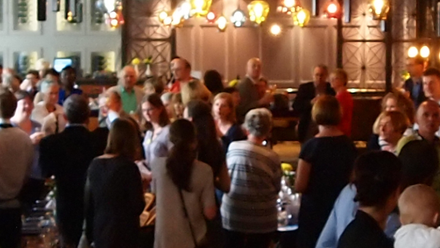
And of course, there was the choir. Once again, Ruth Simpson worked magic, knocking the choristers into shape in just two incredibly packed hours over a couple of days, after which everybody got to stand up and sing at the truly excellent gala dinner. I’m not going to admit just how many notes I got wrong, but it’s such fun, and surely that’s what’s important?
Fingers crossed that I’ll get tickets for Barcelona next year. See you there?
Paul Appleyard
Apart from a brief foray into pre-sales, Paul's entire career (so far) has been in the translation and interpreting sector. He is a Qualified Member of ITI in both translation and interpreting, and also a member of the American Translators Association, the Société française des traducteurs (SFT) in France, and the British Computer Society. Paul is a director of a language service provider with his wife, who is also an MITI. He is a former ITI board member and served as ITI chair between 2020 and 2022.