Shared solutions rather than silos: a different kind of conversation
I came into the language services industry a few months after the launch of ChatGPT, and it is fair to say that generative AI has rarely been absent from my conversations since. Three years on, the technology has evolved considerably, and many software companies have launched AI-enabled translation and interpreting products, yet the longer-term impact on our industry remains quite unclear.
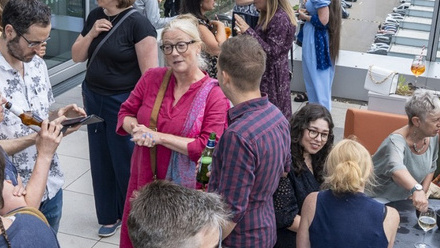
This uncertainty was very much on my mind when I attended elia together 2026 last month. The annual ELIA - European Language Industry Association conference brings together language services companies and professional linguists and this year’s timely theme was “the power of co-creation – collaboration on focus”. Speaking on the closing panel alongside Tayo Ademolu, Martina Ferraina and Povilas Miknevičius, I found myself suggesting that simply acknowledging the uncertainty is itself a useful step. When translators and language services companies (LSCs) share their concerns openly and honestly it becomes easier to have real conversations about what to do next. If we recognise that none of us individually has the answer, we are more likely to look for solutions together. The conference programme also showcased some encouraging case studies of translators, LSC owners and project managers already doing exactly that. This is a really positive development, but it made me question why this felt like a step in a new direction.
The answer is that our industry is not naturally set up for this kind of conversation. Translators and interpreters have their professional associations. LSCs have theirs. Each serves its members well and should continue to do so. But that separation makes it harder to tackle the challenges that affect everyone in the industry.
In this respect ITI is a little unusual. We provide a professional home for individual translators and interpreters, but we also have corporate members – language services companies – which means we sit across the divide. That puts us in a good position to host the kinds of conversations that the industry needs but does not always have a natural home for.
One such conversation took place the following week, when we hosted a roundtable to discuss the findings of the recent Translators’ Work-Related Quality of Life (T-WRQoL) survey. The study, a collaboration between four universities, set out to understand what shapes translators' job satisfaction and career motivation – and what might lead them to leave the profession and was based on data provided by 381 ITI members. The roundtable was facilitated by two of the researchers: Akiko Sakamoto and Félix do Carmo who noted that while overall work satisfaction among translators was moderately high, some ITI members are already seriously considering leaving the profession due to a lack of work driven by the growing influence of AI. Those concerns, expressed in open-ended responses rather than scores, sit in uncomfortable contrast to the more positive figures: two thirds of respondents said they expected to remain in the profession for at least five years. The key issue is not that most translators are about to walk away; it is that a growing number may be thinking about it, and that the industry has it within its power to change that.
The roundtable therefore brought together representatives from LSCs to look at what can practically be done. As Tayler Gilbert MA from ICS-digital put it afterwards, sustainable translation businesses depend on sustainable translator careers – quality outcomes are not achievable without skilled, motivated professionals who feel respected and fairly paid. The conversation was honest about the barriers that remain, but also highlighted positive examples of LSCs already getting this right.
The T-WRQoL survey points to some straightforward conclusions: translators who have more control over their work, a steady flow of projects and direct relationships with clients tend to be more satisfied. None of this is surprising. But acting on it requires LSCs and translators to understand each other better – and that means talking to each other.
Which brings me back to Porto. The most uplifting aspect of elia together was the fact that the room contained people from both sides of the industry who were prepared to be honest with each other. More of that is needed, and it needs to happen more often and in more places.
That is exactly what EX:CHANGE 2026 is for. ITI's conference, which takes place in Milton Keynes in July, has been designed around discussion and participation rather than presentations. The aim is to bring people together to work through real problems collaboratively and to leave with practical ideas. It also marks ITI's 40th anniversary – exactly the right moment to be looking forward rather than back.
EX:CHANGE 2026 takes place on 1–2 July at Unity Place, Milton Keynes. Find out more at: EX:CHANGE 2026 | Milton Keynes