Restricted access
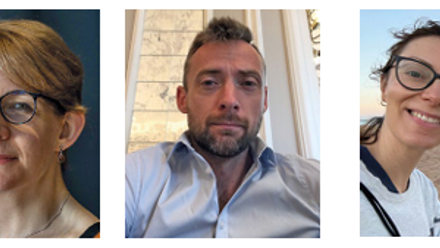
On 25 March 2026, ITI Chief Executive Sara Robertson joined a panel of academics and industry leaders for a webinar hosted by the University of Surrey's Centre for Translation Studies, marking the 40th anniversary of its MA in Translation.
The webinar addressed an important question that we hear frequently from members, students, and the public: given the rapid development of AI tools, is translation still a worthwhile profession to enter?
Studying Translation in the Age of AI - Why and How? brought together representatives from Amnesty International, Revolut, the International Maritime Organisation, the Association of Translation Companies, and the Chartered Institute of Linguists, alongside leading academics from Surrey, Dublin City University, Newcastle University, and Université Laval. The session was aimed at undergraduates, recent graduates, and professionals considering a future in the field.
Drawing on ITI's strategic perspective, Sara argued that the widespread availability of AI translation tools has changed the market in a practical way – many people who would previously have commissioned a professional now believe they can produce a serviceable translation themselves. But this, she suggested, represents a false equivalence between generating a piece of text in the target language and a professionally delivered service that offers a tailored solution. ITI's response to this challenge is to make a clearer case for what professional translation and interpreting actually involves, and why the human qualities that define it cannot be replicated by a machine. At the heart of that case is professionalism.
In setting out the case for advocating more strongly for professionalism Sara refered to her previous remarks about the seven hallmarks of professionalism that apply to translators and interpreters –
These, she argued, are what distinguish a professional from someone who simply has access to a translation tool – and they matter more, not less, in an AI-enabled environment.
Central to ITI's work in this area is its focus on ethics and professional conduct. ITI's revised Code of Professional Conduct, approved by members last year and informed by the Coffee House project run in partnership with Dr Joseph Lambert of Cardiff University, places professional judgement at its centre. Sara argued that professional judgement – the ability to weigh competing considerations, recognise when something is wrong, and take responsibility for decisions – is precisely what AI cannot replicate, and is one of the profession's most important assets that we need to communicate more effectively to clients and stakeholders.
The webinar also forms part of a wider body of work by ITI, ATC, and CIOL on the strategic case for languages in UK higher education, which highlights a growing demand for graduates who understand how language AI works, know where it fails, and are equipped for a professional future combining linguistic, technological, and management expertise.
The student perspective on these themes is captured powerfully in a new article - Translation in the Age of AI: Why there is hope for emerging translators - recently published on the ITI website. Eleanor Manning, an ITI student member currently studying for an MA in Translation and AI at the University of Surrey, writes about the scepticism she regularly encounters from those around her – and why she remains optimistic.
Aspiring translators shouldn't stand back and lose hope. Instead, we should grasp the opportunities this new era presents with both hands.