
Beyond words - changing the perception of the value of translation
Would you like to support this research? Information about how to take part can be found at the end of the article.
The modern marketing translation sector is grappling with a puzzling paradox: How can a growing need for multilingual content coexist with a fall in perceived value of translation?
In todays’ world, marketing translation continues to drive international expansion by enabling companies to communicate persuasively across languages. Recent research by Nimdzi Insights shows that companies stand to potentially double their revenue when they offer products in the user’s native language, highlighting a strong link between marketing translation and return on investment.
The rise of the internet in the 1990s created unprecedented opportunities for international growth, triggering an explosion in digital content and multilingual communication. This environment proved fertile for selling translation as a service and gave rise to the modern language service provider (LSP). Today, just under half of all LSPs operate in this area, and among individual translators it is the second most common specialisation after law.
However, new technologies, shifting client expectations, and emerging professional roles are reshaping how translation is produced, delivered, and valued. LSPs have been compelled to reassess their business models to align with contemporary buyers’ perceptions of translation and, increasingly, their assumptions about what it should cost.
I and my colleagues at the University of Surrey have been conducting an industry-centred research project considering the full translation production chain and looking in each link of that chain for the factors that guide service diversification and change perception of value of translation. In the most recent study, we have identified the factors that LSPs feel determine how translation services are defined and perceived.
The declining demand for human translation
Human translation, as opposed to post-editing (see below), continues to be described as a service in decline. In 2023, a report from CSA Research suggested that we have entered the ‘post-localization era’ characterised by a stagnation in growth for traditional translation services and reduced overall revenues for LSPs as competitively priced post-editing continues to prevail.
This decline in demand for human translation is becoming increasingly visible – and troubling – across the industry. Because human translation still represents a large portion of many companies’ revenue, the downturn poses a significant threat to profitability.
Part of this challenge stems from the nature of translation as a knowledge-based professional service marked by information asymmetry and quality uncertainty. Translators and LSPs naturally possess more knowledge of the service than buyers, and when they recommend higher-quality services, clients often mistake their expertise for self-interest. LSPs told us that they constantly need to reassure clients that they are not ‘anti automation’, and that they are just trying to do what is best for them. When the benefit of different service options is unclear, price becomes the default differentiator.
This dynamic risks creating what economists call ‘a market for lemons' – a situation in which low-cost, low-quality services dominate, gradually pushing out higher-quality alternatives, leading to a further decline in prices and eventual market collapse. On the translation market, this tendency is illustrated by how customised translation is being pushed out by lower-quality post-editing.
The free translation’ mindset
The idea that translation should be free is more widespread than ever. The ubiquity of machine translation (MT) tools such as Google Translate, together with generative AI systems that can produce plausible translations instantly, reinforces the perception that translation is simple, automated and low-value. Raw MT products, provided at no cost, create no direct commercial value, in stark contrast to the value translation providers attempt to communicate.
Many LSPs report growing pressure from clients seeking greater automation, often without understanding its risks or limitations. While providers acknowledge the value of automation, they also emphasise that marketing translation – where nuance, creativity, and cultural alignment drive impact – still depends heavily on human expertise.
Free online MT tools and the current surge in AI have reinforced the perception of translation as a simple mechanical process. When potential clients see that machines produce text that appears serviceable, the communicative function of translation – its true value – is obscured.
Localisation and transcreation have emerged partly as a rebranding strategy to give buyers something more than mechanical word-for-word transfer. These services should offer increased return on investment for translation buyers, but they too suffer from the same information asymmetry that affects the rest of the industry. Many buyers struggle to understand what differentiates them and what extra it is that they get.
Complicating matters further, positioning cultural understanding and communicative effectiveness as added value for premium services strips human translation of a value of its own. It reinforces the perception from industry outsiders that translation is merely a word replacement exercise. So, while localisation and transcreation contribute little to the overall revenue of LSPs, they also inadvertently make it harder to sell translation as a service.
Process descriptions by LSPs indicate that localisation and transcreation generally involve the same tasks as standard translation. The differences lie primarily in the degree of cultural adaptation, the scope for creative change, and in expectations around the products’ resonance with the target audience. For translators, they may also differ in terms of the resources included, time given, and remuneration rates. Without closer examination of real-world practice, however, the extent of this differentiation remains uncertain.
The hidden costs of post-editing
According to various industry reports, post-editing has been the fastest growing service since at least the 2010s. Post-editing is commonly marketed as a faster and cheaper alternative to human translation. The logic is simple: beginning with an MT draft should save time by reducing typing effort. However, previous research has shown that this is not always true, and many translators report on frustrating projects where post-editing required more effort than translating from scratch.
Lower pay rates for post-editing are justified by assumed productivity gains and calculated based on higher expectations of throughput. But when actual throughput falls short of expectations, it is service providers who ultimately have to deal with the consequences. Translators can choose to invest more time in the project at a financial loss or take the professional risk of undercutting quality to reduce losses.
To avoid the risk of overpaying translators, some LSPs exploit post-analysis data to pay only for edited segments. However, research shows that this approach fails to recognise the actual cognitive effort involved in assessing and reworking machine output, which ultimately leads to translators absorbing the cost through spending more time than they are paid for.
These concerns about low pay, ethical issues surrounding AI, reduced job satisfaction, and the sense that the task undermines professional standards mean that many professionals do their best to avoid this area. They are also very aware that shift from ‘writing from scratch’ to editing machine output alters the cognitive dynamics of the translation process. Working from the original target text, translators develop creative solutions and actively select between numerous translation options. Post-editing constrains this process, hindering the production of creative translations that live up to quality expectations, and reducing overall enjoyment of the task. Over time, increased predominance of post-editing risks eroding the skills that define professional translation.
Diversification as a survival strategy
In response to these pressures, service diversification has become central to how LSPs meet diverging buyer needs. Providers now offer a spectrum of services – from fast, low-cost post-editing, to traditional human translation, and on to highly customised localisation and transcreation. In our review of LSP websites we developed a Translation Service Diversification Scale to illustrate how each service aligns with two distinct buyer needs.
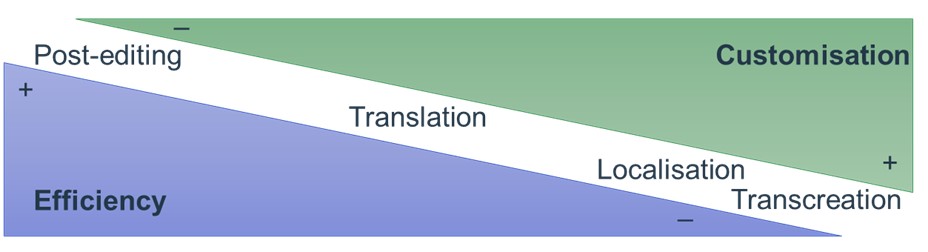
At one end of the scale, post-editing promises efficiency and affordability. At the other, localisation and transcreation are positioned as premium services offering deeper cultural and communicative engagement – a category we describe as customisation.
During service selection, LSPs help buyers prioritise content and allocate investment strategically. Yet customised services remain difficult to sell because buyers often struggle to appreciate the return on investment that they provide.
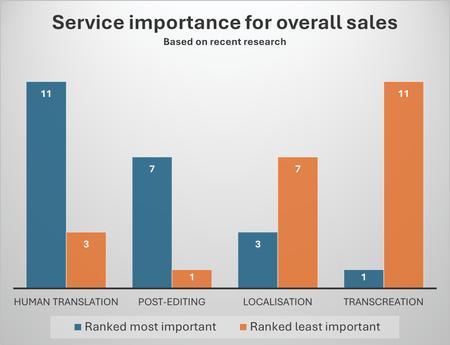
Our recent survey of senior LSP managers shows that localisation and transcreation currently account for only a small share of income. Most revenue continues to come from human translation and post-editing.
Rethinking service diversification
Service diversification is intended to help LSPs meet varied client needs. Paradoxically, however, it may also weaken the industry’s ability to articulate the intrinsic value of translation itself. By reserving creativity and cultural depth for localisation and transcreation, the industry risks portraying translation as a purely mechanical activity.
An overreliance on automation and post-editing also poses a long-term threat to skill development. Many new translators begin their careers working exclusively on post-editing projects, limiting their opportunities to cultivate the experience and judgement essential to high-quality translation.
This places additional pressure on translator training institutions as well. On the one hand, developing traditional translation skills during training becomes even more crucial when the industry offers little chance to hone those skills in practice. On the other, educators must realistically prepare students to expect that technology-assisted workflows dominate entry-level opportunities.
Reclaiming translation’s core value
Translation remains at the heart of the language industry – not as a mechanical transfer of words, but as a complex act of intercultural communication. Every translator knows that translation involves far more than direct substitution. In fact, the very qualities often reserved for other services – efficiency and customisation – could hold the key to strengthening the perceived value of translation.
To protect the future of the industry and the profession, we must urgently reclaim translation as a concept of value and avoid its conflation with the mechanical process of artificial machine translation. Academia plays an important role here, and industry-focused research can help clarify what a sustainable future requires.
What’s next?
Our next study will explore translation practices. We will analyse how marketing translators work across different types of services and how this affects their daily work. Translators are the guarantors of quality and the generators of the productivity that the industry needs. The future of the profession must be shaped with their contribution. If you are an experienced marketing translator, we would love to hear from you. Please complete this form if you want to add your voice to this study.