Churches, pubs, and the translation industry's value problem
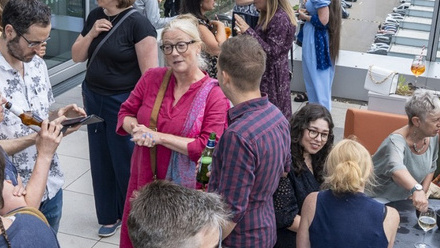
Saying that July has been a busy month would be an understatement. We kicked off July with our conference – EX:CHANGE 2026 – a two-day conversation about the important issues facing the translation and interpreting profession today. You can catch a flavour of the event on our website, where you will also find a couple of the poems produced by our poet-in-residence, Kate Fox. And then our letter making the case for the value of professional human translation to a wider public audience was published in The Guardian.
This was swiftly followed by two professional membership sector events – the Memcom Leadership Skills Forum and a technology-focussed business breakfast meeting. As always, I welcomed the opportunity to talk to fellow professionals from other membership bodies spanning a wide range of business sectors. Many were interested to understand how AI has impacted the language services sector, but what struck me most was that almost everyone I spoke to has a very clear understanding of the limitations and risks of using AI for translation. They all said something along the lines of “of course AI doesn’t understand nuance or context in the way that humans do” and continued by noting that they wouldn’t want to use machine translation in high stakes contexts. My reflection is that our challenge is not that people don’t understand the limitations and risks of using AI for translation; something else is driving the buying decisions made by clients.
Musing further, it struck me that there is a parallel with the challenges I encountered when I worked in the heritage sector.
I spent a lot of the earlier phase of my career concerned with the care and maintenance of historic places of worship. There are around 12,500 listed parish churches in England, and this number includes everything from Saxon chapels (Bradford-on-Avon St Laurence) to grand minsters (Halifax). Spires and crenelated church towers are well-known and much-loved landmarks in our towns and villages. Various surveys have shown that people value these buildings and firmly believe that they should be looked after. However, when pressed, the same people will often admit that they don’t attend their local church – except perhaps at Christmas – and that they don’t contribute financially to its upkeep. So, there’s a disconnect between valuing the building and taking some responsibility for it. This also holds true for village pubs; most people support the idea that there should be a local inn, but prefer to open a bottle of wine at home on a Friday night, and so the business becomes unviable.
What does this tell us about translation?
I think it tells us that valuing something and acting on that value are two entirely different things. Clients may genuinely believe that human translation matters while still reaching for the free machine translation tool on their laptop. The belief is sincere, but it isn’t the factor that drives their decision-making.
So, if awareness isn’t the problem, what is? Perhaps it comes down to friction and immediacy. Using machine translation costs (almost) nothing and takes seconds. Commissioning a professional translation costs money and takes longer. When conviction has to compete with convenience, convenience usually wins – at least until the pub closes, or the poor quality translation causes reputational damage or financial loss.
This is why I keep coming back to one of my regular themes: professional translators and interpreters cannot rely on clients simply recognising the intrinsic value of their skills and knowledge. It is up to all of us to make that value tangible and immediate, and to connect it to the things that genuinely matter to clients – reputational risk, legal exposure, brand image – rather than assuming that an abstract appreciation of quality or nuance will be enough to change behaviour.
Perhaps the real shift we need is how we describe what we do. There is still too much acceptance of translation as a product: a source text goes in and a translation comes out. But end clients aren’t just buying words. They’re buying the confidence that their message will land correctly in a new market, that their contract won’t be misinterpreted, that their brand won’t be embarrassed, or that their patient information leaflet won’t cause harm. That’s not a product, it’s a service – and specifically, it’s a solution to a problem, whether or not the client is able to fully articulate it as such, or not.
Many colleagues working in cultural heritage organisations have learned that simply asking people to appreciate a beautiful building is not enough; they’ve learned to talk about impact and how heritage creates positive outcomes for people and places. We may need to make the same move: from telling clients that human translation is better, to showing them how we use our skills and knowledge to deliver better outcomes. That reframing – from selling translation to selling assurance – is a step towards closing the gap between what clients say they value and what they’re willing to pay for.