
Public perceptions of machine translation
In collaboration with Steffen Eger from the University of Nuremberg and Shimei Pan from the University of Maryland, the AberdeenNLP Research Group has been reasearching what people post about machine translation (MT) on social media. This short article is a summary of a longer paper on Beyond Accuracy: Community Perspectives on Machine Translation.
Additional details can also be found on the Beyond Accuracy webpage.
When talking to professional translators, we often hear about their frustrations, as several user studies have also found through industry surveys (e.g. ELIS 2026). This motivated us to look beyond what AI researchers say based on MT benchmark datasets, and understand how people who develop, use and work with MT think about it. This matters to the translation community because it could help translators, who are not experts in AI, become more aware of recent developments in MT, while also helping AI researchers understand what users really care about. To bring together people with different perspectives, our work analyses social media data, it allows us to listen to a much larger user base across multiple communities. For instance, we ask how AI developers, professional translators, language learners, and translation companies think about MT, and where they (dis-)agree on issues such as translation quality, efficiency, and trust.
Listening to different communities
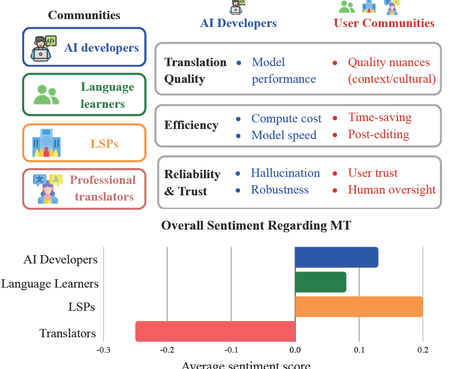
We analysed over 70,000 social media posts and comments, mostly from Reddit and Facebook, between 2019 and 2025. We looked at four groups: AI developers, professional translators, language learners, and language service providers (LSPs).
Interestingly, these groups often talk about the same topics, but from very different perspectives. For instance, when talking about efficiency, AI developers may ask whether an MT system is fast and uses less compute, while translators are more likely to ask whether MT would actually save them time. LSPs have a similar concern, but from a business perspective, e.g., can AI-assisted translation reduce human effort and increase productivity?
Translators are the most critical community
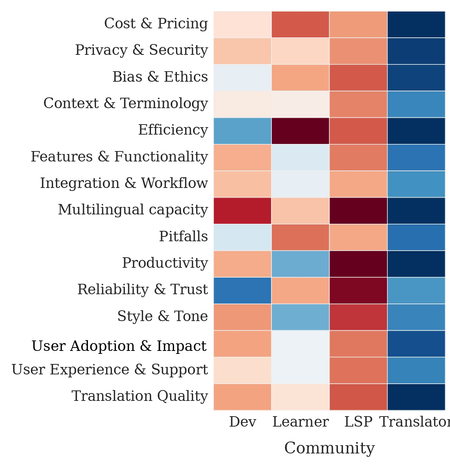
We find that professional translators are the most critical of MT, while LSPs are the most positive. This is interesting because both communities play a major role in the translation industry. LSPs may view MT positively because they see it as a way to increase productivity and revenue, while translators are negative in all aspects, perhaps because they worry about the future of their profession – their work is increasingly reshaped by AI, from how translation is done to broader societal issues such as copyright, compensation, and job losses. Language learners are more neutral, because they do not rely on MT for their jobs, while AI developers are generally more positive, because they see “strong” performance on MT benchmarks.
We also compare how people think about traditional MT systems like Google Translate and recent large language models (LLMs) like GPT. We find that language learners strongly prefer LLMs, because they are easier to use, e.g., allowing for conversation-based translation. But translators and LSPs are more negative about LLMs, perhaps because they are general-purpose models that are not designed for translation.
Beyond accuracy
In the AI community, MT researchers have focused on translation quality for decades, and more recently on issues like efficiency and bias. But they over-rely on benchmark performance, which could explain why they are more positive about MT than the people who actually use it. Listening to users gives us a different picture, as they have different perspectives on what makes MT useful to them. As for translators and ITI, our results could provide useful insights when they engage with AI researchers, translation companies, and policymakers, regarding the future of MT, as well as the use of AI in the translation profession.