Birthday bash - ITI at 35
This article was first published in ITI Bulletin, July–August 2016
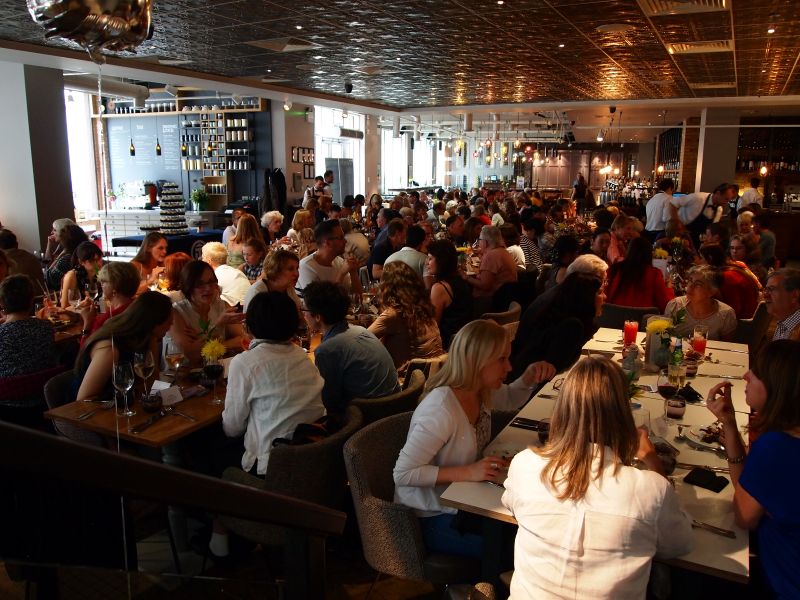
It is not often that as many as 160 of our members manage to get together purely for social reasons, but that was the turnout at ITI's Anniversary Celebration Lunch and Afternoon on 11 June. We had travelled from all parts of the country for a noon appointment at The Anthologist bar and restaurant in the heart of the City of London. Some members had arrived earlier to take part in the choir practice or to join one of the two historic walks around the City, led by a professional guide.
At the entrance to the stylish and spacious venue we were warmly welcomed by ITI operations manager Caroline Wells and events officer Anita Thatcher, who handed us a card headed 'Developing our strategy: from ITI's objectives through to member-led strategic aims' on one side, and 'Meaningful projects moving from planning to staged implementation in 2016/17' on the other. At the top of the tree diagram it said 'Chartership Petition', an exciting drive for the institute to apply for chartered status, which we will no doubt hear more about in due course. After signing the guest list and thank-you card for outgoing chair Iwan Davies, we were handed our personalised place cards, which also reminded us of the three courses we had selected. At the impressive bar we collected our cocktail, the ITI special based on Brit Spritz, or mocktail, blackberry and lavender. We began to spot colleagues we had not met for a while, as well as members from regional groups. It was good to see new faces, too, including students who had not attended an ITI meeting before.
At around one o'clock we put down our place cards at the 16 tables of ten and were treated to a performance by ITI's choir, including a specially composed song to a tune by Franz Schubert:
We come here to celebrate thirty great years,
Translators, interpreters, meeting our peers.
Professionals all, whether novice or sage,
Our aim is to always be worthy of our wage.
So raise your glass and drink to toast
To colleagues who've come here from coast to coast.
After we had enjoyed the beautifully presented starters, Iwan Davies gave a short speech. He asked those members who were present at the inaugural meeting in London on 19 April 1986 to put up their hands, and he expressed his gratitude to all those who on that historic day had voted to break away from the Institute of Linguists and set up the independent ITI. Next, chief executive Paul Wilson said a few friendly words and handed the microphone to the new chair of the ITI Board, Sarah Griffin-Mason. Sarah explained how she had joined ITI as a 19-year-old student, attending her first conference in Cardiff in 2005. (Incidentally, this is also where the next ITI Conference will be held in 2017.) Sarah said she was very happy to be chair and to lead the institute into two directions: 'Inward, making ITI into the leading community of practice for professional translators and interpreters, and outward, convincing the world of potential clients that ITI members are the "go-to" partners in meeting their translation and interpreting needs.' She concluded that she was looking forward to serving the institute for the next three years.
Then, Paul Wilson asked a special guest to join him at the front, 10-year-old Mackenzie Dinella, daughter of ITI member Denise Muir. Living with her parents in both Scotland and Italy, and attending an Italian school at present, Mackenzie is already familiar with the world of languages. She was asked to think of a number between 1 and 156, and the translator corresponding to this number was the lucky winner of a free ticket to next year's ITI Conference.
Flowing freely
After the delicious main course, with red and white wine flowing freely, it was time for round one of the quiz, led by quizmaster Ben. Every table made up a team and the questions consisted of both general knowledge and picture questions. The latter required some serious lateral thinking, which to some of us presented quite a challenge. I was lucky enough to sit at a table with journalist Femke Colborne, editor of ITI Bulletin, and Bulletin art editor, official photographer for the day and seasoned quiz player Mark Richardson, who between them had a sufficiently broad bank of knowledge to steer our team – after the dessert and round two – to a respectable fourth place.
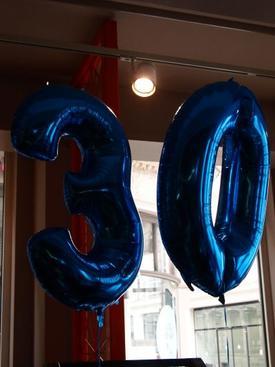
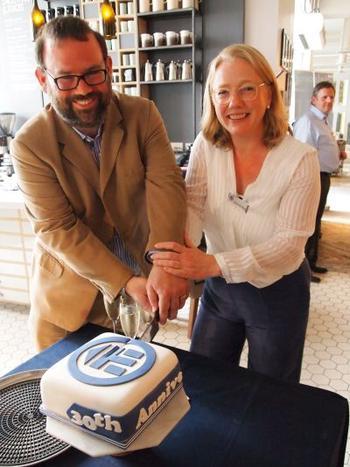
Despite the party's large number, service was prompt and attentive; the waiters even topped up my water more than once. Then came an unexpected treat in the form of a fluted glass of Prosecco spumante and a sensationally fresh-tasting cupcake from an impressive tower of cakes at the front of the room. Now it was time for the celebratory proceedings. Iwan Davies was presented with an ITI plaque to thank him for all the excellent work he has done for the institute in his three years as chair of the ITI Board. Then, he and Sarah Griffin-Mason together cut the royal blue and white 30th anniversary cake, posing for the official photograph. Last but not least, Sarah proposed a toast to absent friends and to the next 30 years, to which we all raised our glasses. To round off the banquet, tea and coffee were available from the bar, and for the winners of the quiz there were prizes. Gradually, people began to get up to greet colleagues at other tables they had not yet spoken to.
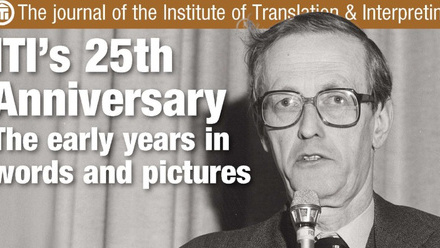
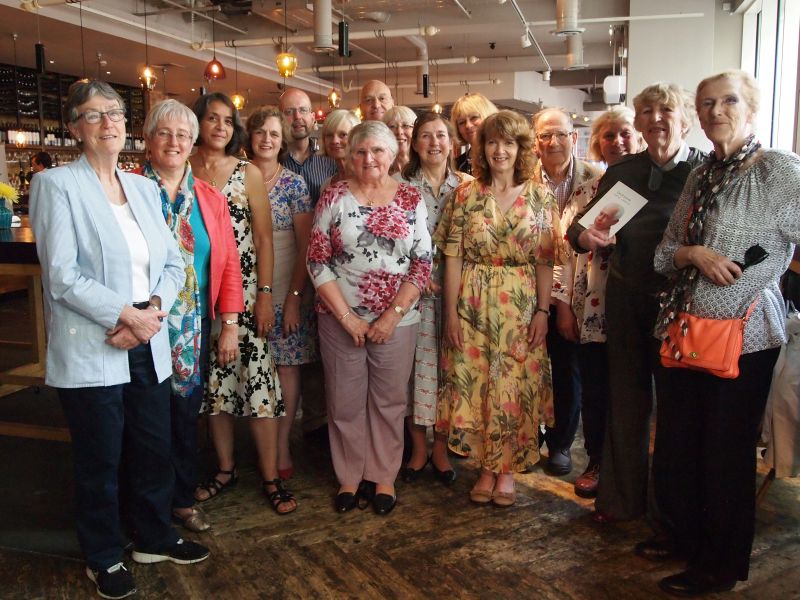
The founder members received a nice surprise when they were asked by Mark Richardson to pose for a special anniversary photograph. Of course, this was only a fraction of the 400 or so qualified members of the Translators' Guild who, led by ITI's legendary first chair John Sykes, formed the core of what was to become the UK's first independent organisation for freelance translators and interpreters. Their names were listed in the first issue of ITI News, the newsletter that was the forerunner of ITI Bulletin (see the article 'From the archive…' in ITI Bulletin March–April 2016). Going round the group, I asked for the names of those I did not know by sight, and we shook hands, asking each other: 'Were you there, too, at the Extraordinary General Meeting at the Royal Horticultural Halls in 1986, and wasn't it tremendously exciting?!' 'Were you in the morning or the afternoon session, because they couldn't fit everyone in at once, remember?!' 'Do you recall making a contribution to the launch fund? I think I wrote a cheque for £75, which was a lot of money to me at the time.' We looked each other in the eye and found a glimmer of recognition, a whisper of a youthful past. 'Is it really that long ago? How quickly time seems to have passed!'
Dynamic body
ITI has come a long way since that very first stapled and typed-up newsletter, steering us through numerous technological developments and improvements in our professional status to a dynamic body with a current membership of some 3,000. For myself, moving out of London to set up as a full-time freelance translator at the end of the year in which ITI was founded, the new language networks, started by Lanna Castellano with the Italian Network, provided invaluable support, mine being the Dutch Network set up by Bob Symonds in 1987, whose members in the UK, the Netherlands and Dutch-speaking Belgium met every year at a weekend workshop. In between those occasions we telephoned each other for help with terminology queries and a catch-up chat, as we did not have email in those days.
Then came the regional groups, kick-started by Chris Percival in the North East, which were of vital importance. My regional group was the nascent Western Group, serving the Bath-Bristol area, whose committee of two I joined in 1989. Our coordinator, Anna George, has just retired after 25 years of service. I especially appreciated having a local group when I was bringing up children and had limited time and resources to attend meetings in other parts of the country. Subject networks followed and at the time of writing we have 11 language networks, 16 regional groups and 12 subject networks. Together they connect translators and interpreters all over the country, leaving the early, London-centric model far behind. We may take all this for granted now, but it was a revolution at the time.
So what of the future? At the end of my article on ITI's 25th anniversary, I quoted founder member Lanna Castellano as saying: 'I think translation will become even more specialised, where we will have to state that we specialise in criminal law, rather than law, and so on.' When I asked her if she thought this was still applicable, five years on, she acquiesced: 'Yes, and more technology.' 'Machine translation?' She nodded. 'Will we all become post-editors, then?' I asked, somewhat dismayed, but then our conversation was interrupted and the answer was left hanging in the air. Having embraced translation memory, our survival as professional linguists will largely depend on how willing and flexible we are in changing with the times. Whatever lies ahead for our profession, I feel that our institute is sufficiently strong and well informed to guide us through. Our festive afternoon in London was a fitting celebration of all that has been achieved so far, and we look forward with expectation and curiosity to the years ahead.
Happy 30th birthday, ITI!
Aletta Stevens is a freelance Dutch mother tongue translator and founder member of ITI. She ran the News of other Associations column in ITI News, ITI's first publication. Her translation of the biography of Dutch film director Paul Verhoeven was published by Faber and Faber. She now specialises in medical translation.